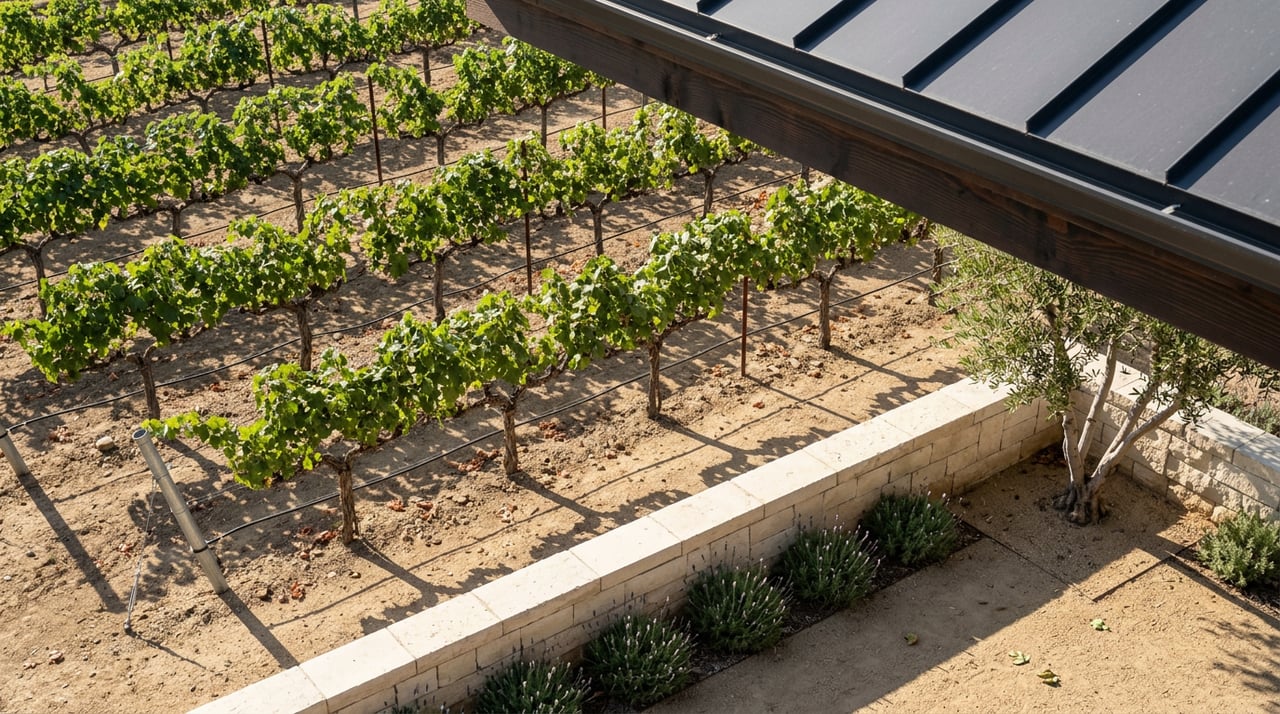
In April 2026, one of Napa Valley's most storied vineyard properties changed hands, and nobody watching the usual channels saw it coming. St. Supéry Estate Vineyards and Winery, owned by the French luxury house Chanel, acquired Rudd Estate, the 65-acre Oakville property Leslie Rudd built into his most personal project before his death in 2018. His daughter, Samantha Rudd, had run it since. The deal included 47 planted acres and the Crossroads brand. The price was never disclosed. There was no sign in the ground, no open house, no listing to refresh on a Sunday afternoon.
That is not an anomaly in Oakville. That is Oakville.
Search Oakville, California on the major portals right now and you will find effectively nothing for sale. Zillow's own site shows zero homes listed in Oakville, Napa, as of this writing in August 2026. For a place with global name recognition, home to Robert Mondavi Winery and some of the most valuable farmland in the country, that emptiness is worth sitting with. Napa County as a whole is a functioning, if cooling, market. Homes there sold over a median of $852,000 in the three months ending April 2026, a figure down 8.4 percent from the year before, with typical time on market stretching to 70 days. Oakville does not appear in that story at all. It does not fail to compete in it. It simply is not measured by it.
The absence of listings is not a gap in the data. It is the data. Oakville's real transactions happen through relationships, off-market conversations, and paperwork most buyers never see, and by the time a deal like Rudd Estate becomes public, it has already closed. What buyers pay in annual regulatory compliance costs once that land changes hands is a separate number entirely, one that got a specific dollar figure attached to it in a 2026 study.
Part of Oakville's thinness is simple geography. It is one of the smallest named places in Napa Valley, a stretch of benchland between Yountville and St. Helena where a handful of families and wine companies have controlled the ground for generations. But the bigger reason new supply almost never appears is legal, and it dates back further than most people assume.
On April 9, 1968, the Napa County Board of Supervisors voted 4 to 0 to create the nation's first agricultural preserve, an ordinance that, as Napa Ag Preserve recounts, declared, in its own words:
"Agriculture is and should continue to be the predominant land use, where uses incompatible to agriculture should be precluded and where development of urban type uses would be detrimental to the continuance of agriculture."
The county pairs its Agricultural Preserve zoning with Williamson Act contracts, and Napa County says that under the current rules a parcel needs at least 10 acres to qualify if it is prime agricultural land, or 40 acres if it is not. According to Napa County, contracts run on a rolling 10-year term No acreage has been released from the preserve since it was created. When people say Oakville is tightly held, this is the mechanism doing the holding. Subdividing a legacy parcel into something a typical buyer could purchase is not a paperwork inconvenience.
Even when Oakville land does trade, the number that eventually leaks out through trade press is only the entry fee. Annual regulatory compliance costs are a separate calculation, and a Napa-specific figure was not available before 2026.
That changed in March 2026, when Cal Poly San Luis Obispo agribusiness professors Lynn Hamilton and Michael McCullough published a study commissioned by the Napa County Farm Bureau. They interviewed one large Napa County vineyard operation of roughly 1,000 acres and one smaller operation of roughly 200 acres and tallied what each spent complying with air quality, water, labor, food safety, and pesticide regulations. The findings gave the industry its first documented baseline:
Peter Rumble, CEO of the Napa County Farm Bureau, put it plainly when the numbers came out, calling the scale of it "shocking." He was reacting to the winery-level follow-up study released this summer, which found that once you add direct-to-consumer sales compliance on top of production regulations, a modest 10,000-case winery pays close to a quarter million dollars a year just in regulatory overhead.
Annual regulatory compliance costs are distinct from a property's per-acre asking price.
| Measure | Napa County overall (3 months ending April 2026) | Oakville |
|---|---|---|
| Median sale price | $852,000 | Not calculable, too few transactions |
| Typical days on market | 70 | Not tracked, sales don't reach public listing |
| Active listings (as of Aug. 2026) | Hundreds across the county | 0 on major portals |
| Large vineyard annual regulatory compliance cost | N/A | About $1,745 per acre annually |
The countywide numbers describe a market that is cooling but still liquid. Oakville sits entirely outside that frame, not because it is more expensive in the way a portal search would show you, but because there is functionally no public inventory to price against.
If Oakville is genuinely on your list, the strategy has to account for both halves of what this data shows. First, waiting for a listing to appear is not a plan, because the properties that matter most rarely become one. Serious interest has to travel through relationships, financing readiness, and the kind of local standing that lets a seller take a call seriously before there is anything to advertise. Second, whatever number eventually attaches to a parcel is the beginning of the math, not the end of it. A buyer evaluating 40 planted acres now has a published estimate to model for regulatory compliance costs, as one part of the annual expense of farming that land.
For sellers, particularly multi-generational families weighing a transition the way the Rudds ultimately did, the same facts cut the other way. A property's value has always rested on more than yield per ton. It rests on provenance, on how cleanly its water rights and Williamson Act status are documented, and on whether a buyer can trust the operating numbers behind the label. That is advisory work, not listing work, and it is exactly why deals like this one close quietly.
Why doesn't Oakville show a median home price on major market reports? Because there are too few recorded sales in a given period to calculate one reliably. County and regional reports that break Napa Valley down by community routinely list Oakville's median as unavailable for exactly this reason.
Is Oakville's tight supply likely to loosen? Nothing in the county's zoning history suggests it. No acreage has been released from the Agricultural Preserve since it was created in 1968, and the current Williamson Act minimums keep most parcels well above what a typical residential buyer could absorb.
Oakville rewards patience and precision more than any other appellation in the valley, and the properties that matter rarely announce themselves. If you're weighing a purchase, a sale, or simply want an honest read on what a specific piece of Oakville ground is actually worth to carry, Ginger Martin has spent decades in exactly this kind of transaction. Get In Touch.
This article is general information, not legal, tax or financial advice. Consult a qualified professional about your situation.
1229 Adams St. St. Helena CA 94574
1229 Adams St. St. Helena CA 94574