If you have been watching Rutherford listings from outside Napa Valley, you have probably seen the headline figure by now. Over the three months ending May 2026, the median home price in Rutherford came in at $1.5 million, down 13.3 percent from the same period a year earlier. Read on its own, that looks like a market correcting. It is not. Rutherford sells a small enough number of properties in any given quarter that one $2 million cottage closing next to one $9 million estate can swing the median by double digits without a single underlying value actually changing. The number is real. The story it seems to tell is not.
The real story in Rutherford right now has almost nothing to do with square footage or comparable sales, and almost everything to do with what is happening one layer down, in the wine business itself.
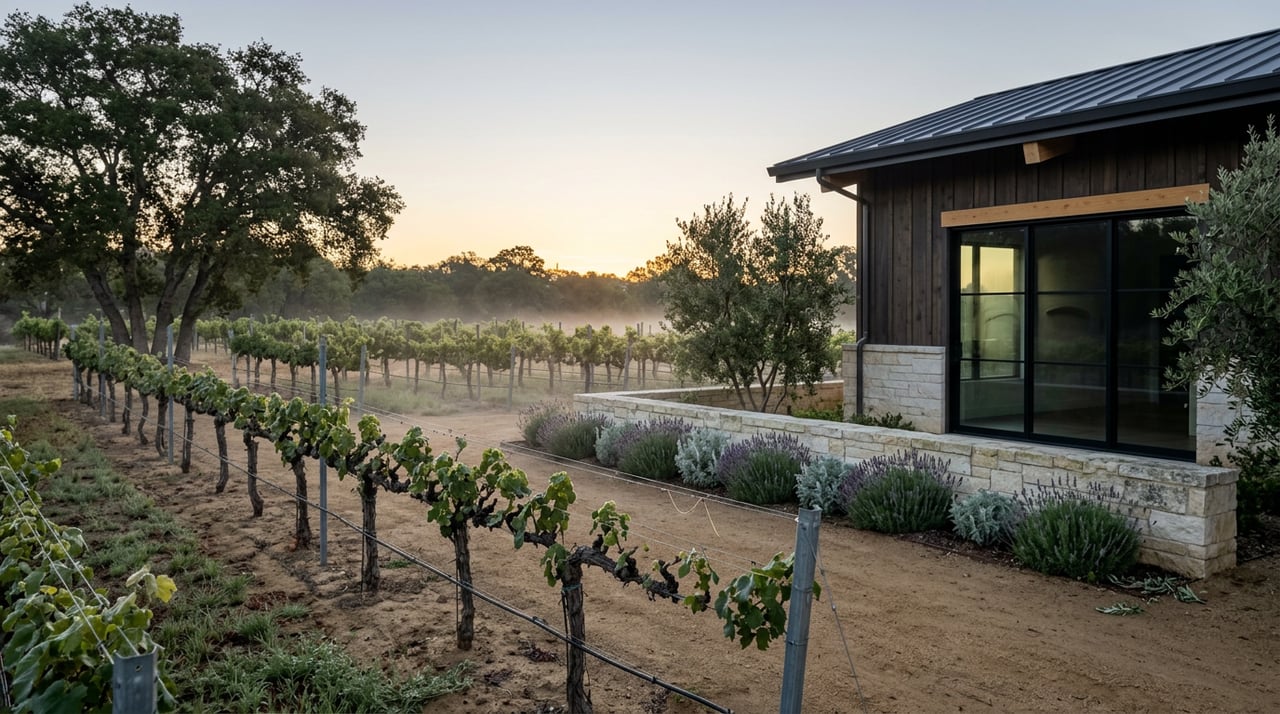
Rutherford is not a residential submarket in the way that term usually gets used. Most properties here carry two assets stitched into one deed: a house, and some acreage of Cabernet Sauvignon vines, Sauvignon Blanc block, or bare plantable ground sitting inside Napa County's Agricultural Preserve. The house gets appraised the way houses everywhere get appraised. The land underneath it gets valued the way an operating business gets valued, on the health of the industry that land serves.
For most of the past two decades, that second valuation has been quietly generous. Rutherford sits on the Rutherford Bench, the gravelly alluvial fan that gives the appellation's Cabernet its signature texture, a character wine chemist André Tchelistcheff at Beaulieu Vineyard famously dubbed "Rutherford Dust." The Rutherford AVA, established in 1993, covers roughly 6,650 acres, most of it agricultural rather than residential, and it has carried some of the highest per-acre vineyard values in the country for a reason: everyone who bought into it for the past thirty years was buying into a wine category that only got more valuable.
That is the part of the equation that changed in 2026.
At an AWG Wine Advisors conference in Santa Rosa on May 21, 2026, land appraiser Tony Correia and merger-and-acquisition specialist Mario Zepponi described the North Coast wine business as being in one of its most severe structural downturns in decades, not a short cyclical dip. Zepponi, who leads BMO Capital Markets' beverage alcohol practice, pointed out that valuation multiples for winery and vineyard deals have fallen by roughly half from their 2021 to 2022 peak, when a handful of blue-chip Napa names fetched more than 20 times EBITDA. The standard multiple now runs closer to 8 to 10 times earnings. Correia, who has appraised Northern California agricultural land for years, estimated that roughly a third of vineyard operations are struggling outright and another third are simply treading water, with more distressed sales likely as lenders lose patience with indebted growers.
You do not have to take that as an abstraction. It has already shown up in Rutherford's own backyard, twice, within the past nine months.
In April 2026, St. Supéry Estate Vineyards, the Chanel-owned winery that already farms two Rutherford estate parcels alongside its winery there, acquired Oakville's Rudd Estate and its Crossroads brand. The San Francisco Chronicle reported that Rudd's founder, Leslie Rudd, had built the brand into one of Napa's most personal projects before his death in 2018. His daughter Samantha Rudd had since sold off most of the family's other holdings, including Oakville Grocery and Edge Hill Winery, and the Rudd Estate sale closed out three decades of family ownership. The Chronicle placed the sale in a string of independent Napa winery owners exiting the business as the industry's downturn deepened, and noted that 46-year-old Cain Vineyards and Winery had been acquired by a San Francisco investment firm just four months earlier, in December 2025.
A Press Democrat report traced the sale of Benessere Vineyards, the 42-acre St. Helena estate that once housed the Charles Shaw brand before it became "Two Buck Chuck." Benessere listed at $35 million in November 2024, came off the market, relisted at a 20 percent discount, came off again in February 2026, and finally went to a forced sale through Concierge Auctions after 18 months of trying to sell it conventionally. Brokers quoted on the sale described the broader luxury real estate market in the valley as uneven, picking up briefly at the end of last year before new uncertainty stalled things again in 2026.
None of these are Rutherford addresses in the strict sense, but they are the exact comp set that determines what the vineyard acreage inside a Rutherford listing is actually worth today. When institutional buyers and appraisers price wine country land, they are pricing it against deals like these, not against the residential comps a home search engine surfaces.
The wine industry's cycle will eventually turn. What will not change, in an up market or a down one, is how little of Rutherford can ever come onto the market at all. Napa County created its Agricultural Preserve in 1968, and parcels inside it cannot be subdivided below 40 acres. A separate rule, the county's 1990 Winery Definition Ordinance, set a 10-acre minimum parcel size before a property even qualifies for a winery use permit. As recently as last year, county supervisors were debating a further one-acre cap on the footprint of new homes built inside the preserve, worried that estate houses were quietly displacing vineyard rows. Whatever the outcome of that debate, it signals how much scrutiny large residential construction on agricultural land continues to draw here.
That combination means Rutherford's supply problem is not cyclical. It is written into the zoning map. A soft wine market can knock the value off the vineyard component of a listing. It cannot make more Rutherford.
For a buyer or seller working through this market right now, the practical takeaway is to stop treating a Rutherford listing like a house with a nice backyard and start treating it like two separate valuations bolted together.
The residential half behaves the way real estate normally behaves: condition, layout, proximity to Highway 29, privacy from the road. The agricultural half behaves like a business interest, and it needs the same questions a buyer would ask before acquiring a stake in any operating company. Is the vineyard on Rutherford Bench gravel or the county's less prized valley floor soil. What is the age and health of the existing plantings. Are the water rights and well capacity documented, not assumed. What is the permit history on any structures built inside the Ag Preserve, since a beautiful house with an undocumented addition can create real complications at closing.
Sellers face the mirror version of the same problem. A Rutherford property that leans hard on its vineyard story right now, at a moment when institutional buyers are paying 8 to 10 times earnings instead of 20, may be better served by leading with the residence and treating the vines as a bonus rather than the headline. The property that gets priced as if 2022 valuations still apply to the acreage is the one that sits, the way Benessere sat, until the market forces a correction anyway.
Does a lower median price mean Rutherford homes are getting cheaper? Not necessarily. With so few transactions each quarter, the median is highly sensitive to which specific properties happened to close, not to any broad repricing of the area.
If I buy a Rutherford property with vines, do I have to farm it myself? Most owners lease their vineyard acreage to an established grower or winery rather than farming it directly. The lease terms, and who currently farms the fruit, are worth confirming early in due diligence.
Can I subdivide a large Rutherford parcel? Generally no. Property inside Napa County's Agricultural Preserve cannot be divided below 40 acres, which is one reason large legacy parcels here tend to stay intact for generations rather than being broken up.
Rutherford rewards buyers and sellers who understand it is priced by two different logics at once, and it punishes anyone treating it as an ordinary comp-driven neighborhood. If you are trying to make sense of what a specific Rutherford property is actually worth this year, on the residential side and the agricultural side both, Ginger Martin has spent decades pricing exactly this kind of land. Get In Touch.
This article is general information, not legal, tax or financial advice. Consult a qualified professional about your situation.
1229 Adams St. St. Helena CA 94574
1229 Adams St. St. Helena CA 94574