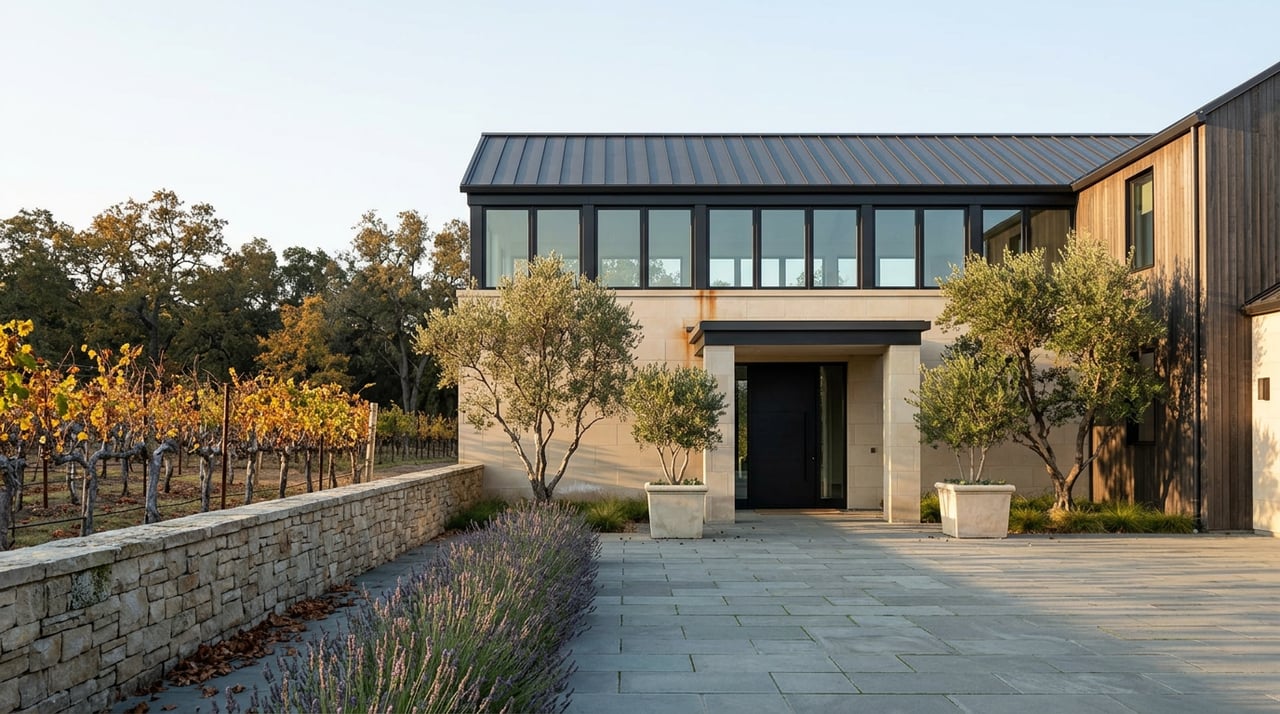
"It's like catching a falling knife." That's how one Sonoma County agricultural appraiser described the vineyard market this spring, in comments to the Press Democrat after an industry conference in Santa Rosa. It's not a line you'll find on a listing page, and it won't show up next to the median sale price of a home. But if you're looking at property in Sonoma Valley with vineyard acreage attached, it's the number that matters more than the one on the sign.
Here's the friction most buyers don't see coming: in Sonoma, the house and the land underneath it are pricing on two different curves right now, and the county's own rulebook is proof of it.
In late August 2026, the Sonoma County Board of Supervisors unanimously advanced changes to the Vineyard Erosion and Sediment Control Ordinance, known locally as VESCO. The county adopted VESCO in 2000, in the wake of a major 1998 landslide, to govern how growers could disturb hillside soil for planting. It has been a fixture of every vineyard purchase and replant in the county since, and a genuinely contentious one.
The 2026 revision does one specific thing: it creates a faster path for growers to swap out and replant crops, including winegrapes, as long as the cultivated footprint stays the same. A grower pulling out a failing block of Cabernet and putting in something else no longer has to run the full erosion-control gauntlet, provided the vines go back in roughly where they came out.
What stood out wasn't the policy. It was the room. A board discussion over a rule with this much history took thirty minutes. Mike Martini, speaking on behalf of the Sonoma Alliance for Vineyards and the Environment, thanked supervisors for moving the change forward, saying keeping land available for agriculture matters for everything it has brought the community. Don McEnhill of Russian Riverkeeper, an organization that has fought over vineyard rules before, told the board his group hasn't seen a water quality problem since growers began pulling vines the previous summer and said the organization is mindful of the industry's difficulty. A second, formal vote was scheduled for September 2026 before the change takes effect.
A county does not quietly loosen a 26-year-old land-use ordinance, with the support of an environmental group that once fought it, unless the alternative to loosening it is watching working land go idle.
The downturn behind that vote is not new, but it has kept getting worse. The 2025 grape crush across the North Coast came in at roughly 185,500 tons, a decline of nearly a third from peak, and the value of the harvest has fallen with it. Sonoma County's crop was worth $777 million in 2018. By 2025, one estimate put it closer to $523 million, a comparable one-third decline in dollar terms. Karissa Kruse, president of Sonoma County Winegrowers, estimated that roughly 30 percent of the county's grapes went unsold in 2025. Growers responded the way growers respond to oversupply: they pulled vines. Roughly 2,700 acres, about 5 percent of the county's planted vineyard, came out between October 2024 and August 2025.
At the same May conference where the "falling knife" comment was made, appraiser Tony Correia put it plainly: if a grower has to sell land today, the price is going to be lower than it used to be. He described the market in tiers rather than as one block, saying that at the bottom, perhaps a third of vineyard properties are struggling, and another third in the middle are just treading water. Mario Zepponi of BMO Capital Markets, also on the panel, said he expects the industry to emerge from this cycle smaller than it went in, with real improvement unlikely before 2028.
| What the home says | What the vineyard says | |
|---|---|---|
| Time window | 3 months through May 2026 | 2025 harvest year |
| Headline figure | Median home sale price in the city of Sonoma: $1.2 million, up 4.7% year over year | County grape crush: ~185,500 tons, down nearly a third from peak |
| Second figure | Average house price the prior month: $1.11 million, down 9.0% year over year | Harvest value: an estimated $523 million, down from $777 million in 2018 |
| Volume | 43 homes sold in May 2026, up from 35 a year earlier | ~30% of local grapes went unsold in 2025 |
| Trend | Homes averaging 34 days on market | ~2,700 acres of vines pulled, Oct. 2024 to Aug. 2025 |
Read across that table and the mismatch is the point. The residential side is a thin, choppy dataset, 43 closings is not a large sample, and a single high-end sale can move a median by a wide margin from one month to the next. That's why the median is up while the average, a different measure over a different window, is down. The agricultural side isn't choppy at all. It's a five-year slide, documented by county crop reports and state crush data, and it's the reason the Board of Supervisors just changed how it treats replanting.
A listing price for a Sonoma Valley property with planted acreage is really two prices stacked together, and right now those two prices are not moving in the same direction. Before treating the total as one number, it's worth asking:
None of these questions show up in a listing description. They show up in escrow, usually after an offer is already in, which is the worst time to learn that the vineyard component of a purchase is worth meaningfully less than the seller's asking number implies.
The same pattern shows up at the corporate level. In mid-November 2025, The Wine Group, one of the industry's largest producers, listed its Imagery Estate Winery property in Glen Ellen for sale, with no price disclosed. The facility hadn't produced wine on site for up to two years at the time of the listing. The move came just two months after The Wine Group sold the historic Simi Winery brand in Healdsburg. When a company holding roughly 6,600 acres of vineyards across its portfolio starts shedding production facilities inside Sonoma Valley itself, it's the same signal as the county easing its own ordinance: an acknowledgment that the ground underneath the wine business has shifted.
None of this means Sonoma's residential market is in trouble. Homes are still selling, still commanding a wine country premium, and the median is still trending upward over the past year. What it means is that the vineyard acreage attached to a Sonoma Valley estate is being priced by an entirely different set of forces than the house sitting on it, and a buyer who treats the two as one figure is going to be surprised at some point in the transaction. The county's own regulatory posture, easing a rule specifically written to protect against erosion, tells you which direction that surprise is likely to run.
Does the VESCO change affect a property that's just a house, with no working vineyard? No. The streamlined pathway applies specifically to erosion review for replanting or swapping crops on land already under cultivation. A residential parcel without planted acreage isn't touched by it.
If vineyard land is losing value, does that mean Sonoma home prices are falling too? Not directly. The residential and agricultural components of a Sonoma Valley property are pricing separately right now. A home's total value still depends on how much of the number reflects the house and how much reflects the acreage, and that split is exactly what's worth working through before making an offer.
If you're evaluating an estate in Sonoma Valley with vineyard acreage attached, the conversation that matters most happens before the offer goes in, not after escrow opens. Ginger Martin has spent decades pricing the land and the home as two separate questions for buyers and sellers across Napa and Sonoma. Get in touch to talk through what's actually anchoring the number on a specific property.
1229 Adams St. St. Helena CA 94574
1229 Adams St. St. Helena CA 94574