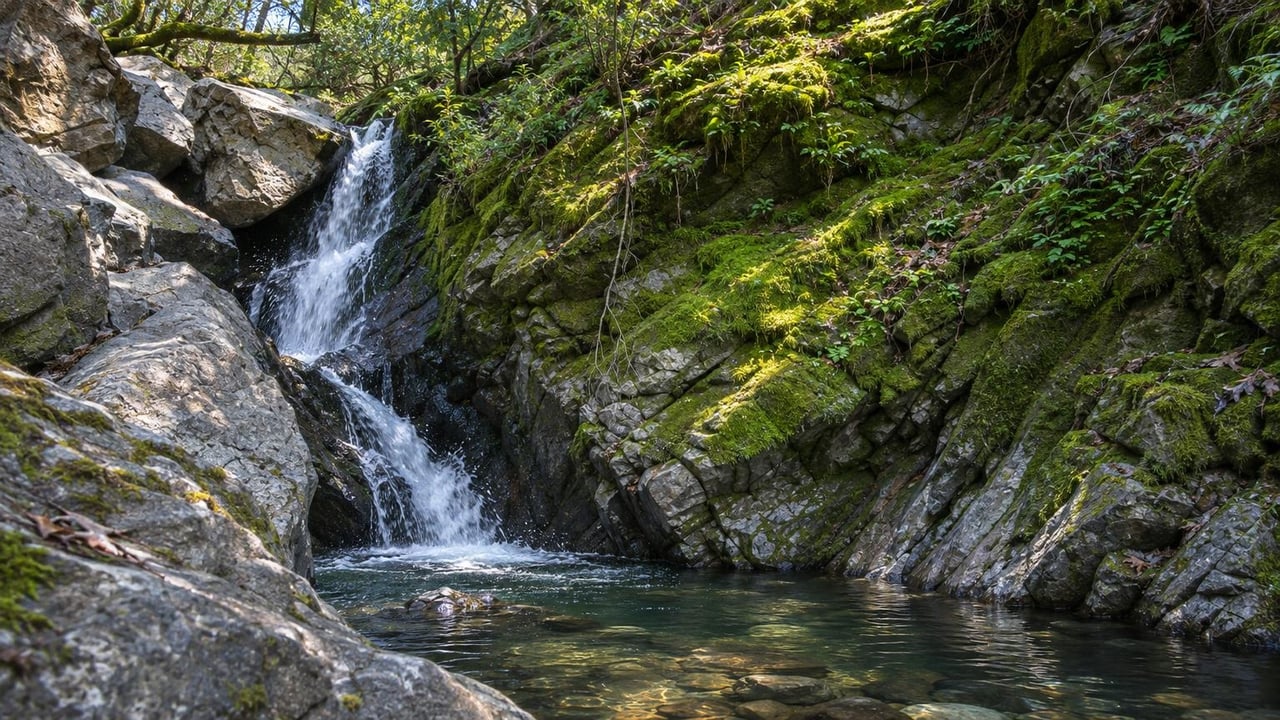
Sugarloaf Ridge State Park was on California's closure list during the state park budget crisis, and it closed in December 2011. Fifteen years later, on the morning after Thanksgiving, docents will meet families at the Visitor Center and lead them out on two routes. One goes down to the 25-foot waterfall on Sonoma Creek, and the other is a shorter walk along the creek. That night, the observatory up the road holds a Public Star Party.
The hike and the star party come from the same local arrangement. The state still owns Sugarloaf, but since 2012 local nonprofits have run it, and the calendar they publish from now into February is mostly guided walks, small classes and nights at the telescope. Most are free or cost about what a sandwich does.
The park keeps a weather station at the Visitor Center, at 1,200 feet. From Nov. 12 through Nov. 18, it recorded 5.08 inches of rain. Of that, 3.40 inches fell on Wednesday morning alone, including 1.04 inches in a single hour. For the same storm, the Sonoma Water gauge on Bald Mountain recorded 2.91 inches, and early Wednesday gusts reached 42 mph at the Visitor Center.
Sonoma Creek starts in this park. It runs through a gorge and canyon, crosses the meadow floor and drops over a 25-foot waterfall that flows after winter rains. A week like that is the winter rain the falls depend on.
The storm left some housekeeping. In its latest conditions update, the park says all roads and trails are open but not every route has been patrolled since the storm, so hikers may find downed trees, rocks or branches. The park office takes reports at 707.833.5712 from 9 a.m. to 5 p.m. every day, and by email at [email protected] after hours. The page also asks hikers to check with the Visitor Center or entrance kiosk before heading out, especially after storms.
To see the falls, the park recommends the two-mile Canyon–Pony Gate loop. It rates the loop moderate. The Canyon Trail alone reaches the falls by a shorter, steeper route with stairs.
The docents' description of the loop is more specific than the trail map. Pony Gate is a narrow footpath, steep in places, and drops 450 feet. It crosses a seasonal creek with no bridge, which is unsafe right after storms. Pony Gate comes out on the lower part of Adobe Canyon Road. A few yards down and across the road, the Canyon Trail steps down to a fairly flat, narrow path along Sonoma Creek with two very narrow wooden bridges before the turnoff to the falls. Between that turnoff and the upper Canyon trailhead are about 120 built-in steps. The upper trailhead comes out on Adobe Canyon Road about half a mile from the main parking lot. If you're walking with someone who would rather skip the stairs and the crossing, the Creekside Nature Trail is an easy, shaded one-mile loop that follows the creek from near the picnic area.
A week after a storm, that crossing on Pony Gate is the detail that matters. It's also why the guided Black Friday hike plans two routes.
The winter calendar starts the day after Thanksgiving. Everything below is listed by Sonoma Ecology Center for the park. Parking fees apply unless noted.
All three fitness hikes ask for an RSVP, and all three run from 9 a.m. to 1 p.m. Two of December's guided walks are about mushrooms, on Dec. 5 and Dec. 27.
The other half of a Sugarloaf winter happens after the parking lot empties. The Robert Ferguson Observatory sits inside the park. The Valley of the Moon Observatory Association, a nonprofit, is responsible for building, maintaining and using it.
The observatory's public nights start on Black Friday with a Public Star Party, Nov. 27, from 7 to 10 p.m. The next one is a Saturn Focus Night on Dec. 5 at 6:30 p.m. That's the same Saturday as the morning fungi walk, so a family could spend the morning looking down at the forest floor and the evening looking at Saturn. On Dec. 13 there's a Geminids Focus Night. The new year brings a Public Star Party on Jan. 30, a Jupiter Focus Night from 8 to 10:30 p.m. on Feb. 6, and another Public Star Party on Feb. 27.
This fall, California State Parks posted a request for interest in a 10-year concession to operate the observatory. The notice is on the park's California State Parks page.
All of this traces back to 2012. After the December 2011 closure, a coalition called Team Sugarloaf took over operations under an agreement worked out with State Parks, and the state kept ownership of the land. The Sonoma Index-Tribune reported in 2017 that the coalition had five partners: Sonoma Ecology Center, Valley of the Moon Natural History Association, Sonoma County Trails Council, United Camps Conferences & Retreats, and the Robert Ferguson Observatory. Team Sugarloaf officially took over operations on June 1, 2012.
The same Index-Tribune report has the figures. The operating budget for 2012–13 was just over $300,000, and two years later it was $465,000. Donations, entry fees and fundraising paid for both. In the state's last full year of running the park, Sugarloaf had 5,858 day-users and 4,093 overnight campers. Five years later, it had 15,560 day-users and nearly 7,600 camping nights. Those are 2017 figures, but they show that the park grew under local operation.
The coalition has since narrowed. Today Sonoma Ecology Center operates the park on its own, and the Valley of the Moon Observatory Association runs the observatory. That's why the docent hikes, Spanish-language walks, tai chi mornings and Saturn nights all appear on one calendar with one parking kiosk.
Day-use parking is $10 per vehicle, or $8 for seniors 62 and older, students, and current or retired military. An annual day-use pass is $59 and also works at Jack London State Historic Park in Glen Ellen. At the regular rate, six visits cost more than the pass.
Dogs are welcome in the park on a leash but aren't allowed on the trails. The park has 25 miles of trails for hiking and horseback riding, through oak woodland and chaparral. On a clear day, the 2,729-foot summit of Bald Mountain has views of both the Sierra Nevada and the Golden Gate Bridge. Gray Pine and Hillside both have seasonal creek crossings, so the warning for Pony Gate applies to them after a storm too.
The campground is open all year. Regular sites are $35 a night and premium sites $45. Reservations open up to six months ahead, and same-day first-come sites are handled by phone at 10 a.m. The park notes that weekends and holidays fill quickly, so guests in town over the holidays who want to sleep near the observatory should book soon.
Sugarloaf is part of what an address in Kenwood comes with: a creek that starts in the park, an observatory on the ridge, and local nonprofits running both. Ginger Martin + Co. works with land and homes across Sonoma Valley, Kenwood included. If you'd like to talk through land or a home near Sugarloaf, get in touch.
1229 Adams St. St. Helena CA 94574
1229 Adams St. St. Helena CA 94574